Posts

Addressing the Effects of Poverty on Basic Education

Image
Poverty profoundly affects education. Poverty's grip on education manifests on the first day of school. Children from poor families are less prepared in kindergarten. Learning gaps are already substantial and are only bound to grow. Recent research in the United States on kindergarten preparedness mirrors the gaps observed in later stages of basic education highlighting the importance of addressing the effects of poverty on education during the early childhood years. Academic gaps based on socioeconomic status are only expected to persist if we keep ignoring the significance of a holistic approach in early education. Investments in preschool education have increased in the United States. Parents are now much more aware in their vital role of preparing their children for school. Yet, academic gaps measured at the beginning of formal schooling remain associated with socioeconomic status (SES): Above copied from Emma Garcia and Elaine Weiss, Economic Policy Institute, September...

A Scientist Costume for Halloween?

Image
My children did not pick a scientist costume for Halloween. That is good, I guess. Judging from children's books, the image children have regarding scientists may not be flattering. Take, for instance, Mr. Galvin, the science teacher in Big Nate, or Dr. Diaper from Captain Underpants. Above copied from DailyStrips Above copied from Thirty Days Later and I'm Still Thinking Why dress up as a decent scientist when a costume for a mad scientist is less than half in price. Above copied from Google Popular culture provides young children with images of a scientist. Unfortunately, even with books for young minds recommended by the National Science Teachers' Association, according to research published in School Science and Mathematics ,  there are clearly stereotypical images: "This study utilized the Draw-A-Scientist Test Checklist (DAST-C) to assess the illustrations of scientists in the most recent three years of NSTA Recommends book lists. A total of...

"School Myths"

The Atlantic has a new Facebook page that tackles misinformation in basic education in the United States. The page is called " School Myths ". The Atlantic  writes, "“School Myths,” a new series by The Atlantic, debunks some of the more persistent misconceptions taught in classrooms across America, from the fallacy of the food pyramid to the pitfalls of the grading system." Its first episode posted weeks ago tackled lessons on nutrition taught in classrooms. Unfortunately, the information provided to students in these lessons are now known to be largely incorrect. The food pyramid in the nineties has now been shown to be misguided. The problem is not only with the wrong facts but also on the inherent bias behind the guidelines as the nation's Food and Drug Administration is in reality a federal government agency that promotes the United States food industry. These myths do linger. For instance, we continue to demonize coconut oil while ignoring the fact that not...

Middle School: A United States Experience

Image
My son is currently in his first year in Middle School. He reads both "Big Nate" and the "Diary of a Wimpy Kid". Anya Kamenetz in a recent article posted on NPR, " Switching To Middle School Can Be Hard On Kids, But There Are Ways To Make It Better ", starts with a quote from the "Diary of the Wimpy Kid": "I'll be famous one day, but for now I'm stuck in middle school with a bunch of morons." There are countries in the world other than the United States that have middle school in basic education. The Philippines is not one of those countries. Even with its new K to 12 curriculum, there is no middle school. One may suggest that grades 7-10 are now junior high school and 11-12 are senior high school, yet that distinction still does not match the fact that in the United States, middle school and high school involve separate schools, separate set of teachers and administrators. Anyway, my son's experience with middle school i...

Inequity in Education

Image
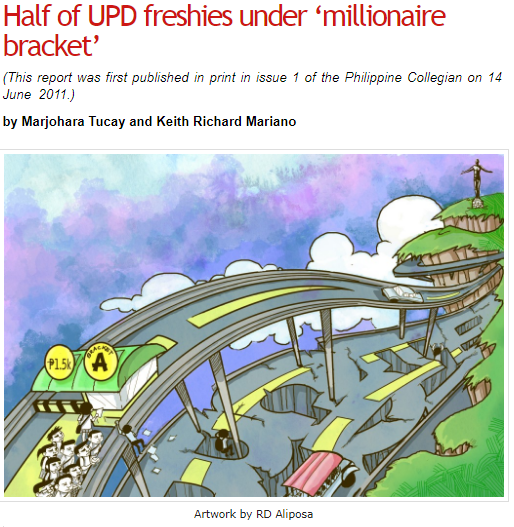
Jason A. Grissom and Christopher Redding of Vanderbilt University find that African American children are less likely to attend gifted programs in basic education. The same is true for Hispanic children. While 16.7% of the student population are Black, only 9.8% in gifted programs are African American. For Hispanics, 22.3% of students are Hispanic yet only 15.4% of students enrolled in gifted programs are Hispanic. Such is a glaring demonstration of inequity in basic education. In the Philippines, although the population is more or less homogeneous in terms of race, a much more striking inequity exists according to family income. In 2011, the Philippine Collegian reported that half of the entering class in the University of Philippines, Diliman campus are from "millionaires". Above copied from the Philippine Collegian This year, there are no tuition and miscellaneous fees because of the new law that covers these expenses for all state universities and colleges. In the...

"Young Children Are Spending More Time in Front of Small Screens"

Image
The title of a news article must accurately reflect its content. "Young Children Are Spending More Time in Front of Small Screens" is the title of an article posted on NPR . In this case, the title is quite accurate: Children are indeed exposed to small screens as "98 percent of homes with children now have a mobile device such as a tablet or smartphone". The survey made by CommonSense  finds that usage of smart devices by children under 8 has skyrocketed from 5 minutes per day in 2011 to 48 minutes per day in 2017. Above copied from CommonSense Whether this trend is a good reason to worry about requires a deeper appreciation of what the title really says. The title does not say, "Young Children Are Spending More Time in Front of Screens". Missing the word "Small" in "Small Screens" changes what the news is about. In fact, the survey finds that the total screen time has barely changed from 2 hours and 16 minutes per day in 2011 ...

"Love to Learn"

Image
The following is a guest post from Mike Tomelden, who directs a school feeding program in the Philippines, Good Men Feeding Program. It is always easier to appreciate a post by seeing photographs of the children in need. So we start here with the children and end with a brief description of Tomelden's project (More information is provided on the Facebook page, The Reading, Literacy and Feeding Program ): Love To Learn  by Mike Tomelden Grade 1 Previous weight: 34.2 lbs. Current weight: 38.2 lbs. Grade 2 Previous weight:  30.36 lbs. Current weight:  32.2 lbs. Grade 2 Previous weight:   38.5 lbs. Current weight: 42.5 lbs. Grade 2 Previous weight:     42.2 lbs. Current weight:   55 lbs. Grade 2 Previous weight:  39.38 lbs. Current weight: 52.0 lbs. Grade 3 Previous weight:  43.6 lbs. Current weight:  50 lbs. Graduates of the Let’s Read program and beneficiaries o...