Posts

Showing posts with the label Education for All

"I Still Have A Dream": Equity In Education

Image
"I still have a dream. It is a dream deeply rooted in the American dream." These were words spoken in front of the Lincoln Memorial in 1963. At that moment, after about a hundred years after emancipation, we were all made aware that the bank of justice was way behind schedule as Black Americans were still "sadly crippled by the manacles of segregation and the chains of discrimination" .  But more than fifty years after those words were spoken, the dream had remained elusive. Aspirations come early in life. Parents wish nothing but the best for their children. Yet, we continue to charter the course of so many children based on their skin color or socio-economic status. Martin Luther King's dream can never be achieved without equity in education.  Above copied from History More than a year ago, a panel in New York City took the bold step of recommending that advanced education programs, such as those designed for "gifted" or "talented" studen...

Merit Lottery for Admission to Thomas Jefferson High School

Image
As long as we use metrics that place privileged families at an advantage, admission to any advanced academic program will remain inequitable. The reason is simple. Any system can be gamed by families who have more resources. Only a lottery can provide a genuine opportunity for underrepresented groups at Virginia's premier school, Thomas Jefferson High School. There is evidence to back this up. As noted by a professor from Georgia, Charles Pibel, Gwinett School of Mathematics, Science and Technology (GSMST) accomplishes this. Considered as one of the top high schools in the country, GSMST has about a third of its students coming from underrepresented groups. The Gwinnett School of Mathematics, Science, and Technology Above copied from USNews One can compare the above demographics with that of Thomas Jefferson High School: Thomas Jefferson High School for Science and Technology Above copied from USNews The difference is so glaring. Only 2% of students at Thomas Jefferson come from lo...

Teaching Racial Sensitivity Is Not Insane, White Supremacy Is

Image
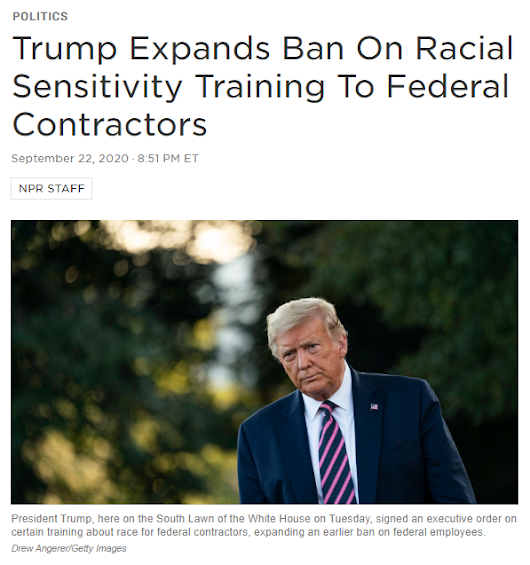
We can never solve a problem without facing it. When a black school board member tells me that she would always get stopped at a grocery to show her receipt after self-checking out while others would not get checked, we need to pay attention. Yes, there are gaps due to socio-economic status, but it must also be taught that a significant source of these differences lies in racial injustices in our society. Work places need to be made aware of the importance of inclusion and diversity. Schools are, of course, important as children grow in a society where racism has become too banal. When we have a president who says,  "If you were a certain person, you had no status in life. It was sort of a reversal, And if you look at the people, we were paying people hundreds of thousands of dollars to teach very bad ideas and frankly, very sick ideas," , the more we need to teach our children as they grow up to recognize and respect their own and those of cultures, the more we need to show ...

Annandale Wants Change

Image
My spouse and I have spent the largest fraction of our lives in this community called Annandale. Last night, my wife help organized a march. In the words of another resident, James Albright: "First protest I have ever known of in Annandale. Hundreds upon hundreds protesting in front of Mason District police station". We did not expect a very large crowd, yet hundreds of families from Annandale came, which actually made social distancing very challenging. It started with a march along Columbia Pike from Barcroft Center to the Mason District Police Station. Inside the parking lot of the police station, people knelt in silence for 8 minutes and 46 seconds, the same amount of time a police officer knelt on George Floyd during his final moments. Afterwards, the people, adults and children, of Annandale spoke up. Names of African Americans brutally killed by the police were read by the son of Ricardy Anderson, Mason District representative to the Fairfax County School Board. ...

We Voted For ONE Fairfax

Image
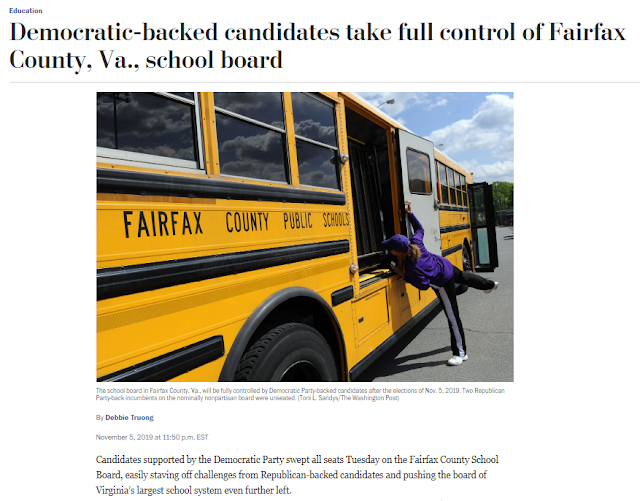
Elections unfortunately do not solve problems. What we do after the poll matters. However, we do bring what we value to the ballot box and it is crystal clear that yesterday, we, at Fairfax county, voted for equity, diversity and inclusiveness. The paths to these values are not easy. These values will challenge some of our strongly held preconceived notions. For this reason, it is imperative that we listen to what evidence tells us. The Washington Post  states that the Democratic supported candidates winning yesterday pushes the Fairfax County School Board further to the left. This is not about left versus right. The winners of yesterday's school board elections rejected elitism, intolerance and division. Our new school board embraces "education for all". Our new district representative, Ricardy Anderson, for instance, wrote this last night, "...as we work to close the achievement gap that cripples our most vulnerable." Above copied from the Washington Post...

Advanced Academic Programs Hurt Basic Education

Image
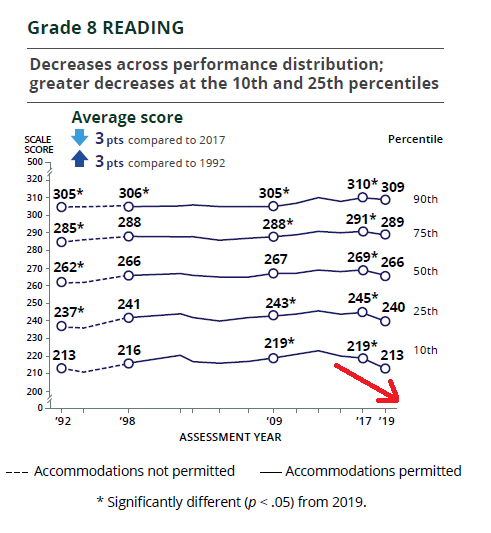
The Nation's Report Card actually provides strong evidence against advanced academic programs. In a post on this blog a year ago, " Gaps Are Increasing in the Nation's Report Card ", a troubling trend has become evident, low achieving students are scoring even lower over the years. Well, the 2019 results are now available and the scores are sadly continuing with this trend. And the reason behind this trend maybe simple: Schools are providing two different curricula - and the instruction depends on whether the student is deemed low-achieving or high-achieving. This outcome should not come as a surprise since this is what happens with ability-grouping in basic education. It benefits no one but harms students who are struggling. Above copied from The Nation's Report Card (NAEP 8th Grade Reading Scores) This time, I will not be citing a cartoon nor a comic strip, but a study done by the National Center for Education Statistics. Above copied from Educati...

Advanced Academic Programs Only Contribute to Inequity

Image
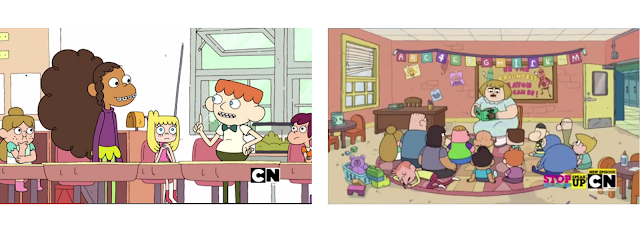
It has been three decades since Robert Slavin at Johns Hopkins University told us in " Achievement Effects of Ability Grouping in Secondary Schools: A Best-Evidence Synthesis " that there is no educational benefit in grouping students according to what we perceive as their academic abilities. On the other hand, there is a clear drawback: Inequity in basic education. Receiving responses that are sometimes quite virulent on posts where I call for removal of advanced academic programs makes me realize that some parents actually fear public school education. Basically, parents fear that the curriculum provided to the students not deemed advanced is bad. This is the same reason why bringing equity to education is sometimes viewed as catering to the lowest common denominator. I guess I would be equally concerned if my child not deemed advanced is then asked to go through the word "the" as practice for sight reading over and over. Is this fear grounded on reality? Sadly, i...

What Would Fairfax County Do With Its Advanced Academic Program?

Image
Near the end of last year, the school board of Fairfax county decided to review its advanced academic program . Part of the decision is to seek advice from experts in advanced academics programming and equity. The board wants to hear what experts have to say. Well, experts in another school district in the United States, New York City public schools, have already spoken. Their recommendation is the immediate elimination of "gifted programs". One can guess then that in the near future the board at Fairfax county will face the same question New York City mayor Bill de Blasio is facing: Should one implement what experts recommend when the recommendation can possibly lead to political suicide? Above copied from Making the Grade II One simply has to look at comments posted on news articles reporting this recommendation to grasp the strong objection to this recommendation. Here are examples from the Washington Post : Unreal.  The “progressive” race to the bottom con...

Are Schools Equalizers?

Image
Horace Mann, one of the first great advocates of public education, wrote in 1848, " Education then, beyond all other devices of human origin, is the great equalizer of the conditions of men, the balance-wheel of the social machinery ." As pointed out by Adam Harris at the  Atlantic ,  there are "schools that are bringing poor kids into the middle class". I guess it is easy to cite a particular instance in which a child born in a low socio-economic family is able to climb up to a higher income bracket later in life. And in most cases, this feat is indeed made possible by education. Unfortunately, anecdotes are often exceptions to the rule. Citing one or two or even a hundred cases is not enough evidence to show that schools are indeed equalizers. Recent research demonstrates that schools in the United States are in fact not equalizers. Without looking at the evidence, it is tempting to hypothesize that schools are great equalizers if one assumes that inequity is m...

"Them That Has, Gets"

Image
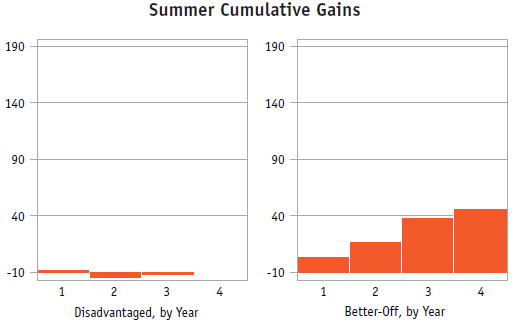
It is a phrase that summarizes well a rule in organic chemistry, Markovnikov's rule , the carbon that has more hydrogen gets the hydrogen. Sadly, this rule likewise applies to basic education. Achievement and skill gaps between poor and rich children are already present even before kindergarten. And it has long been accepted that these gaps only grow with years of schooling. A study that started in 1982 even demonstrates that the difference between disadvantaged and better-off students grow during the summer months. Above copied from Summer Can Set Kids on the Right—or Wrong—Course Recently, Paul T. von Hippel and Caitlin Hamrock have questioned the validity of the summer learning loss. In a study published in the journal Sociological Science , these authors conclude that the summer learning loss is simply an artifact of how children are tested. Above copied from von Hippel, Paul T., and Caitlin Hamrock. 2019. “Do Test Score Gaps Grow Before, During, or Between the Sc...

Segregation Not Only Happens Between Schools But Also Within A School

Image
Like Ricardy Anderson (Democratic nominee for school board from the Mason District), I have a child enrolled in Advanced Academic Program Level IV. Similarly, I also have chosen to keep my child in the same school instead of transferring her to a designated school for advanced academics. Keeping a child in the same school does look like preventing segregation but as Whitney L. Pirtle, a sociologist and professor at the University of California Merced,     recently notes on the  Atlantic , "The public focuses its attention on divides between schools, while tracking has created separate and unequal education systems within single schools." Above copied from The Atlantic As parents, we do want the best for our children. But we must make this desire apply to all children, not just ours. Pirtle ends her article with both sadness and honesty, "While my individual actions and choices are important, their impact is limited. Until we can develop better admissions tests...

Equity in Education Requires a Change in Mindset

Image
We cannot work toward providing each and every child the opportunity to excel, if we ourselves cling to a sense of hierarchy. When we continue to view people in terms of ranks or even levels of importance, we are not truly promoting a climate where equity can thrive.  Mel Ainscow at the Center for Equity in Education at the University of Manchester noted, "it is clear that there is much that individual schools can do to tackle issues within their organizations, and that such actions are likely to have a profound impact on student experiences, and perhaps have some influence on inequities arising elsewhere." Our own actions teach. How we run our schools teaches students. For this reason, equity can only be achieved if we not only teach it, but also live by it. Brian Butler, the former principal at Mason Crest Elementary School, the school that has won recognition as an outstanding model for a professional learning community, illustrates this change in mindset in the way he ac...

Advanced Academics for All

Image
I serve in two committees in my county's school district: Advanced Academics and Title One Parent Advisory Committees. And it is interesting that one advocacy may actually fit in both: "Advanced Academics for All", since Title One schools are attended by students who are often underrepresented in advanced academic programs. It may sound unreasonable but latest research actually shows that advanced academics actually help not just in math and reading, but also in developing social-emotional skills, for both low- and high-achieving children. Above picture copied from Rockwall ISD Vi-Nhuan Le and coworkers examined the ECLS-K:2011 dataset, which contained data for more than 11000 children and 2600 teachers in kindergarten. The advanced academic content of each classroom was measured in terms of how frequent language arts and mathematics skills were taught. These were combined with the social-emotional outcomes as well as two stages of language and math assessments. T...

"Collective Intelligence"

Image
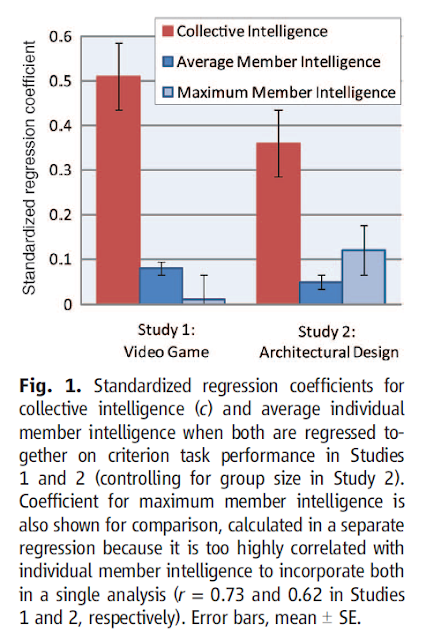
When Jonathan Plucker and coworkers wrote " Talent on the Sidelines: Excellence Gaps and America's Persistent Talent Underclass ", they cautioned us, "One reasonable criticism of the 2010 study was our reliance on standardized test data at the national and state levels." Plucker and coworkers recognize that they are reducing the definition of excellence to proficiencies in math and reading. This indeed is a narrow view of education, but even with "a broader range of indicators — for example, 21st century skills or measures of creative productivity" as Plucker and coworkers have suggested, their view remains incomplete because it focuses on human performance at the individual level. This is a major problem because it is no secret that the current frontiers of human knowledge are multidisciplinary thereby requiring a number of viewpoints. Thus, with 21st century challenges, what we also need to look at is "collective intelligence". We are ve...

The Advanced Academic Program of Fairfax County Public Schools

Image
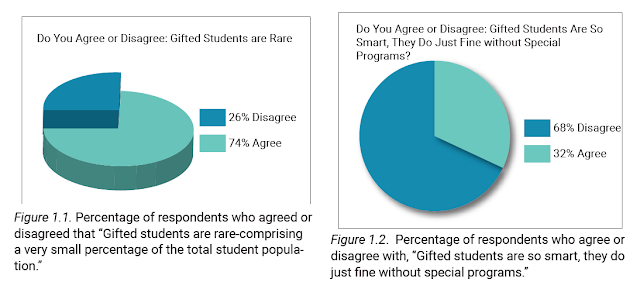
The Institute for Educational Achievement has just released an advanced reading copy of a report entitled " AMERICA AGREES: PUBLIC ATTITUDES TOWARDS GIFTED EDUCATION ". The report is a "compilation of results from a national opinion poll assessing the general public’s understanding of and attitudes towards gifted education". One major finding of the poll is that the American public has a good grasp of what "gifted" means, and how this greatly differs from a "high achieving" student. This distinction is reflected in the following items the poll includes: Gifted students are rare, and gifted students need special programs. In the poll, gifted students are considered different from high-achieving students. High-achieving students are often characterized as students with "Guts, Resilience, Initiative and Tenacity (GRIT)". In addition, a supermajority of Americans agree that giftedness is not associated with family income. In Fairfax county,...