Posts

"We Feel, Therefore We Learn"
Image
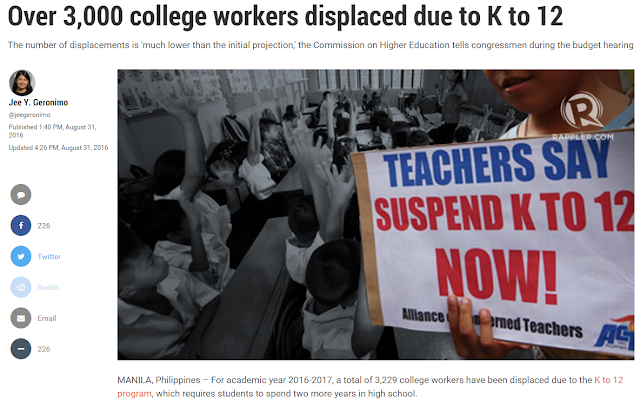
A news article today on Rappler  relates the sad and unfortunate displacement of over three thousand college workers due to DepEd's K to 12. It starts with a statement made by the Philippines' Commission on Higher Education (CHED) during a hearing in Congress: "The number of displacements is much lower than the initial projection". The callousness is truly remarkable. Above copied from Rappler Somehow, the commission seems to have mastered a perfect dichotomy between logic and feelings, between cognition and emotion. Perhaps, it is important that the commission takes into heart and mind results from neuroscience research that demonstrates the strong link between feeling and learning. In an article published in the journal Mind Brain, and Education , We Feel, Therefore We Learn: The Relevance of Affective and Social Neuroscience to Education, Mary Helen Immordino-Yang and Antonio Damasio have laid out clearly what neuroscience research is telling us about emot...
Parents Are Key to Improving Basic Education

Image
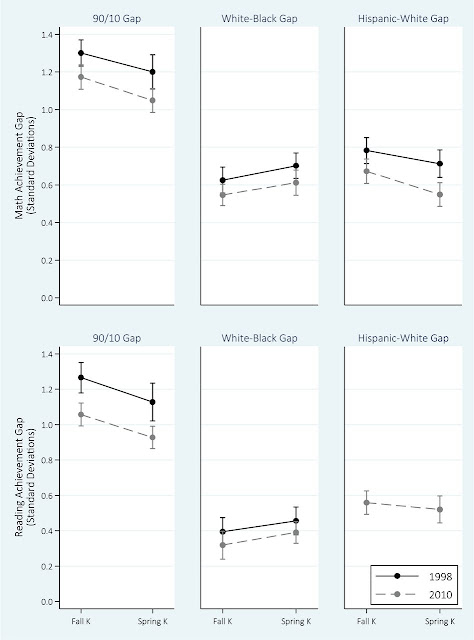
Surprising results have been recently reported regarding the achievement gap in kindergarten in the United States. Sean F. Reardon and Ximena A. Portilla report in a study published in the journal AERA Open  that the kindergarten school readiness gap between poor and rich children has narrowed significantly during the past decade. This is promising. It suggests a further decline in the achievement gap in the later years of basic education. It is surprising because income inequality has significantly widened during this time period and yet, the achievement gap has done the opposite. The actual cause still needs to be determined but the best guess at the moment is what parents are doing. Above copied from Recent Trends in Income, Racial, and Ethnic School Readiness Gaps at Kindergarten Entry Sean F. Reardon, Ximena A. Portilla AERA Open Aug 2016, 2 (3) 2332858416657343; DOI: 10.1177/2332858416657343 The 90-10 gap represents the difference between children from families belongin...

"Poor Children Have Smaller Brains"

Image
It is a dangerous headline for it implies fate. It is harmful as it suggests intellectual inferiority on those who are born to poverty. Yet, a similar headline can be seen even from the news section of the science journal Nature : "Poverty shrinks brains from birth". Above copied from Nature The above headline is actually a lot more sensational than the headline employed by the research article described in the news article. Above copied from Nature Neuroscience Unfortunately, a lot of people often do not go beyond the headline. Obviously, people are even less expected to read the original article. One simply has to see one of the graphs in the research article to appreciate what the differences really are: Above copied from Noble, K. G.   et al .  Nature Neurosci.   http://dx.doi.org/10.1038/nn.3983  ( 2015 ). Sadly, people probably would likewise fail to see and read the following paragraph from the research article: "As a final point,...

Surprising Results Regarding Retention

Image
During my days of schooling and it is perhaps true up till now, retention is seen as bad. In a world where nobody is perfect and failure is inevitable, it is indeed surprising that retention is widely perceived as detrimental. A lot of research do show that retention may have negative effects. However, it should be clear that what is actually done with retention can significantly affect the outcome. ASCD's article, What Research Says About... / Grade Retention , ends with a wise statement, "Without early diagnosis and targeted intervention, struggling students are unlikely to catch up whether they are promoted or retained." Above copied from Pinterest Thus, studying the effects of retention must be carefully designed. A paper scheduled to be published in the Journal of Educational Psychology , looks at the effects of retention by examining more than a hundred students that have been retained from a total sample of more than a thousand students in 42 secondary school...

"Valuing Teachers, Improving their Status"

Image
"Valuing Teachers, Improving their Status" is the theme of this year's World Teachers' Day, October 5, 2016. Of course, the status of the teaching profession can not be simply reduced to how much a teacher gets paid. Still, money talks. Teacher salaries do speak of how much we value our teachers.  In the United States, the Economic Policy Institute has recently released a study that shows that teachers' pay is significantly lower than those of other college graduates. And in the Philippines, the story is pretty much the same. Representative France Castro (Alliance of Concerned Teachers) says that public school teachers are only taking home about 3,500 to 6,000 pesos (75-130 US$) every month: 18 August 2016 PRESS STATEMENT Reference: Rep. France L. Castro Rep. France Castro on DBM Sec. Diokno's anti-poor statement Rep. France Castro of ACT Teachers Party-List denounced DBM Sec. Benjamin Diokno’s 'anti-poor statement’ when he said “there is...

How We Solve Arithmetic Problems - How We Solve Societal Problems

Image
Multiplication and division involving either fractions or decimals that are less than one persist as major challenges in fifth grade classrooms. Punching these decimals into a calculator, provided that the correct buttons are pushed, can of course lead to the right answer. Knowing how to do these arithmetic operations by hand likewise can be successful, but the question of whether a child really understands the concept of multiplication and division involving fractions remains to be addressed. Without such understanding, a careless handling of a calculator or an error in computation by hand can easily happen and at the end, a child is completely unaware that his or her answer does not make sense. A recent study involving seventh graders from a public school near Pittsburgh shows that students continue to fail in this area. The work, scheduled to be published in the Journal of Educational Psychology , looks at how well a student answers an arithmetic problem involving decimals. The fo...

How We Treat Our Young Children

Image
"In one study of extra-year programs, the biggest gains were not for the extra-year children but for the at-risk children who have received extra help in the regular classroom", noted Shepard and Smith in their paper, " Synthesis of Research on School Readiness and Kindergarten Retention ". Shepard and Smith had long argued that schools should address the diversity of young children when they enter kindergarten and not focus on applying a common set of standards for all. Sadly, a list for kindergarten readiness, which includes the ability to "identify 30+ letters", is what parents see, for instance, from a county in Ohio. Above copied from SheKnows School readiness as well as school entry age are issues difficult to address in research since learning outcomes are often determined by factors other than these two. As a starter, context matters. In addition, how schools respond as Shepard and Smith had shown can easily sway the results simply based on a...