Posts

Setting Priorities

Image
When I was in fourth grade, one day in the month of October, I decided that I could start walking from school to home instead of taking public transportation. The cost then was twenty five centavos per ride. Thus, in eight weeks, I would be able to save ten pesos, which would be enough to buy a new pair of pants, just in time for the holiday season. That need seemed urgent to me at that time since I was just about to earn the nickname "baduy"(someone whose clothing is out of style or uncool) from the other kids in the neighborhood. And I did manage to reach my goal, but when Christmas came, my parents decided that what I was able to save could be used to answer more urgent needs, such as food on our table. I trusted my parent's wisdom in setting priorities. I did end up with "baduy", but my parents did spend the money I saved on more important things. We often live with limited resources. Setting priorities is therefore inescapable. The need for making decisio...

Learner-Centered Education

Image
DepEd's K to 12 curriculum is advertised as learner-centered. It focuses on the optimum development of the Filipino child. ( K to 12 Toolkit: Reference Guide for Teacher Educators, School Administrators, and Teachers, 2012 ) These two sentences are quite loaded and upon closer examination, these statements are actually very problematic. First, there are two major actors inside the classroom, the teacher and the students. Learner- versus teacher-centered in education is clearly a false dichotomy. Such thinking only sows an unnecessary disaccord between teaching and learning. Second, emphasizing the Filipino child suggests that education is racially dependent. The United States is a melting pot and studies have firmly established that "within-group differences exceed between-group differences". With these precarious and misguided principles, arriving at a poorly designed curriculum therefore becomes inevitable. Knowledge should not be constructed in a vacuum. Otherwise, ...

Congestion in DepEd's K to 12

Image
Congestion means overcrowding. In simple terms, there is too much in too little space or time. To avoid congestion one can either increase space or time, or reduce whatever is taking space or time. In introducing K to 12 to the Philippines, the Department of Education made the claim, "... the sad state of basic education can be partly attributed to the congested basic education curriculum. " A closer examination of DepEd's K to 12, however, reveals not a decongestion, but a reduction of instructional hours across the first ten years of education. Here are the changes for elementary school: Above copied from K to 12 Toolkit There is a reduction in both languages and mathematics of about 10 percent in instructional time. Below are the changes in secondary school: Above copied from  K to 12 Toolkit Here, the decrease in instructional hours is even greater. Science, for instance suffers a 33 percent reduction. Adding two years to basic education may indeed look ...

Senior High School Years

Image
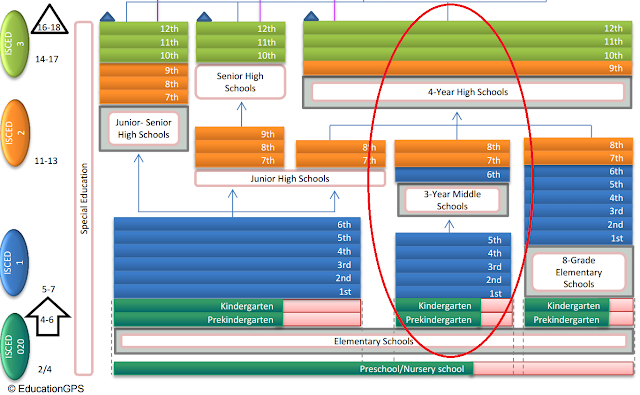
Analyzing the additional years of DepEd's K to 12 requires careful attention to details. For instance, proponents of the new curriculum are always quick to cite that the Philippines is the last country in Asia and one of only three countries in the world with a 10-year pre-university program. Unfortunately, such statement does not cover what is truly missing in Philippine basic education and what other countries are really doing. Without this thoughtful consideration, DepEd's K to 12 manages only to address the number of years but not the real challenges Philippine basic education faces. Education programs can be uniformly classified using  UNESCO’s International Standard Classification of Education (ISCED) . ISCED 2011 has nine levels of education, from level 0 to level 8: • ISCED 0: Early childhood education • ISCED 1: Primary education • ISCED 2: Lower secondary education • ISCED 3: Upper secondary education • ISCED 4: Post-secondary non-tertiary education • ISCED ...

Class Size and Learning Time

Image
The latest report from the OECD, Education at a Glance , released on November 24, 2015, provides data regarding the state of education in various countries. One of the chapters in this report deals with class size and its relationship to learning. The report states, " larger classes are correlated with less time spent on actual teaching and learning and with more time spent on keeping order in the classroom... ...Specifically, one additional student added to an average size class is associated with a 0.5 percentage-point decrease in time spent on teaching and learning activities.... " The following is the figure that captures this finding: Above copied from OECD (2015),  "Indicator D2 What is the Student-Teacher Ratio and How Big are Classes?", in OECD,  Education at a Glance 2015: OECD Indicators , OECD Publishing, Paris. DOI:  http://dx.doi.org/10.1787/eag-2015-31-en The Philippines is not included in the above study, but one can extrapolate where Phil...

Thanksgiving: A Story for All Children to Hear

Image
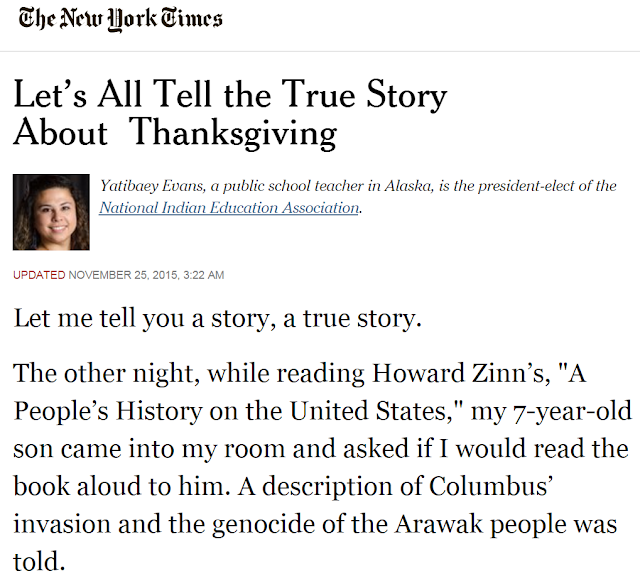
Yatibaey Evans writes a thought-provoking article on Thanksgiving in the New York Times . Her first paragraph talks about the dark yet truthful side of American history. She is making the case of teaching children not just the sugar-coated events but also the failures and injustices of our past. A fuller picture in Evans' opinion may in fact shine light on lessons children should learn. Evans is currently the president-elect of the  National Indian Education Association . She writes the article through the thoughts of her seven-year old son. Above copied from the New York Times I was born in the Philippines. Growing up, I have been taught a thing or two regarding European colonists. It is not a happy story. After finishing college and teaching for two years, I went to Chicago for my graduate studies and that was the time I was introduced to the Thanksgiving holiday. These past few weeks, even in the  Karate  school of my son, the master was taking time to teach ...

Why DepEd's K to 12 Is Not Education for All

Image
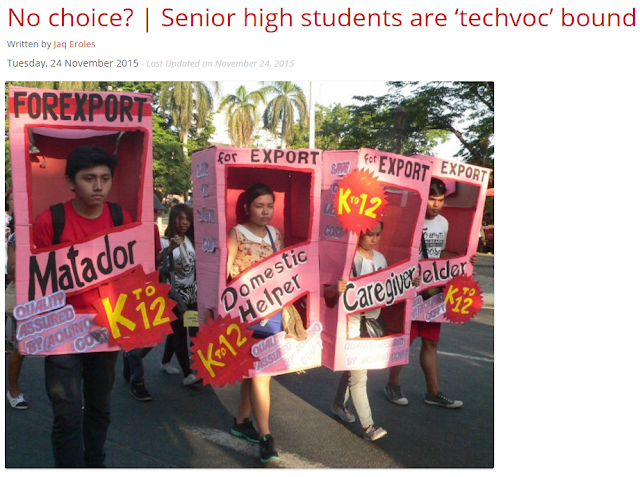
DepEd's K to 12 adds two years to high school and its enabling act, Republic Act 10533  increases the number of years of compulsory education to thirteen from the six years of compulsory elementary education prescribed by the country's constitution . Public basic and compulsory education implies full responsibility of the government. Basic education means it should be available for all. Looking at what is available tells an entirely different story. It truly says a lot more about how the Philippine government has abandoned its task of providing basic education to all. Jaq Eroles recently wrote an article for the Philippine Online Chronicles : In the article, Eroles provides data on what type of Senior High School years are in fact available for students. Eroles uses text to relate the data. However, it maybe useful to translate these numbers into figures. For the National Capital Region (NCR), out of 10 high schools, only 7 are able to offer Technical-Vocational-Liveli...