Posts

PISA 2022: No Change in Dismal Perfomance of the Philippines

Image
It is the second time, since the adoption of the new K to 12 curriculum, that the Philippines participated in The Programme for International Student Assessment or PISA. PISA is a triennial survey of 15-year-old students around the world in three subjects: reading, mathematics and science. The results remain dismal for the Philippines. For the second time, PISA has shown that 15-year old students, who are near the end of their junior high school in the Philippines, are not learning basic skills in readsing, math and science, demonstrating convincingly that Philippine basic education has serious problems in the early years. The above shows that the scores remain essentially the same between 2018 and 2022. For reference, the figure below shows the scores in 2018. The scores are nearly identical to these ones. The scores in the 2022 exam are 347 (Reading), 355 (Math),  and 356 (Science).
"Every Student Deserves a Gifted Education"

Image
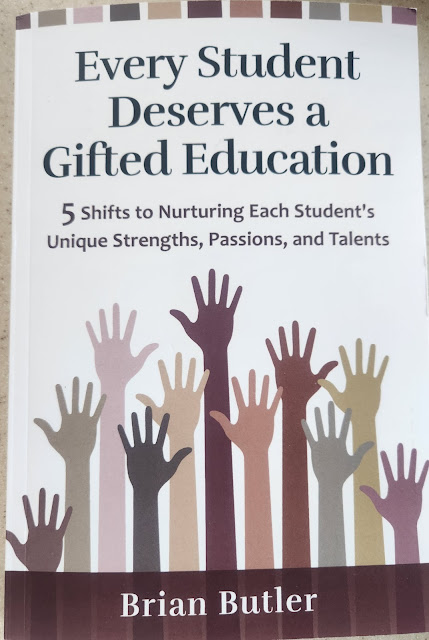
What a real pleasant surprise to see this in my mailbox when I got home today. It was a copy of the #1 New Release in Amazon books on Education Administration. In this book, Brian Butler speaks the hard truth about what we are currentlly getting wrong in basic education. Every student deserves a good education. That is what "gifted" really means. And as Brian Butler strongly states in the title of his book, every child deserves a good education. Every child is unique in talents and strengths. Every child is precious and gifted so every child must be matched with good quality instruction. When we begin to categorize children as early as elementary school, all we are doing is labeling them according to their parents' resources. That is not "gifted". That is "privilege". Limiting good education to children born with privilege will only exacerbate inequity in society, completely undermining our objective of providing education for all.  To order at Amazon,...

DepEd Has a New Curriculum

Image
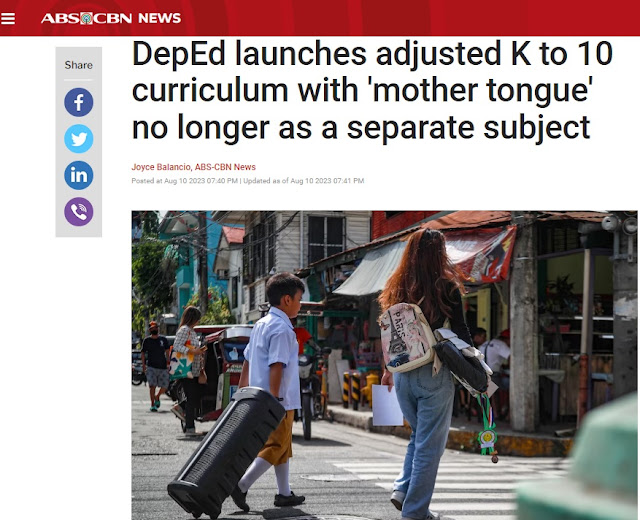
After more than ten years, the Department of Education in the Philippines has now taken steps to revised its ill-advised K plus 12 curriculum. The new curriculum, called MATATAG K to 10 curriculum addresses some of the issues I raised in the first post on this blog.  Above copied from ABS-CBN News As a summary, these are the changes according to    ABS-CBN News : In the present system, there are the seven identified foundational skills or learning areas for students: mother tongue Filipino English Mathematics  Araling Panlipunan MAPEH Edukasyon sa Pagpapakatao Under the adjusted K to 10 curriculum, learning areas are reduced to only five: Language Reading and Literacy Mathematics Makabansa GMRC (Good Manners and Right Conduct) There are likewise suggestions that the spiral approach in teaching math and sciences in grades 7 to 10 would be removed. The K plus 12 curriculum was clearly a wasteful experiment in the past ten years. It led to no improvement in basic educat...

What Does AI Say About Lack of Recognition for Scoring High in PSAT?

Image
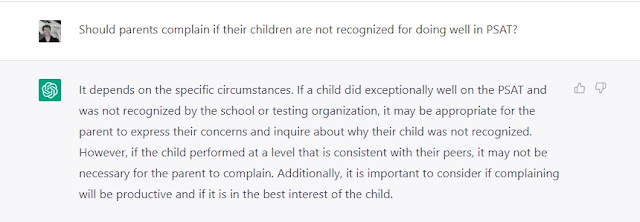
I have not posted on this blog for some time. Of course, that does not mean a lack of interest or concern. Schools are still trying to recover from the pandemic and the problem of inequity in education remains pressing. There is something novel, however, that has caught the attention of educators: Artificial Intelligence. There is now ChatGPT, a program that can write a paragraph when provided a prompt, which is quite alarming for classes that require students to write essays. So, I tried it this morning and this is what I got: It is reasonable. In fact, ChatGPT is more reasonable than some parents in Fairfax county. Recently, some high schools in Fairfax county failed to notify their students of reaching a commended status in the PSAT. Just to be clear (from nationalmerit.org):  What does it mean to be National Merit Commended? Commended Students are named based on a nationally applied Selection Index score that may vary from year to year and is typically below the level required ...

It's Not The Bell, It's The Bimodal That We Should Eliminate

Image
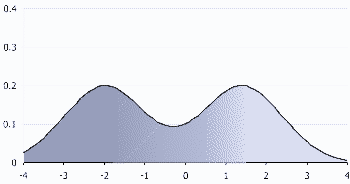
Mike Mattos, a leader in professional learning communities, reminds educators that they must work to eliminate the "expectation that student achievement should plot across a bell-shaped curve". Of course, with the primary objective of "learning for all", a bell curve definitely points out that we are unsuccessful. The problem, however, is more serious than a bell curve. As Professor Massimo Boninsegni of Alberta pointed out years ago , a bimodal distribution is much more insidious. A bimodal distribution The above distribution can be seen in introductory science courses in college. A class with such a distribution can be divided into two groups. Oftentimes, the class is composed of two types of students: students who have taken advanced science courses in high school and students who have not. When such a distribution appears, it is apparent that some students are not seeing new material, while others are seeing topics for the first time. As someone who teaches an i...

Weak Gun Laws Correlate with Higher Children Gun-related Death Rate

Image
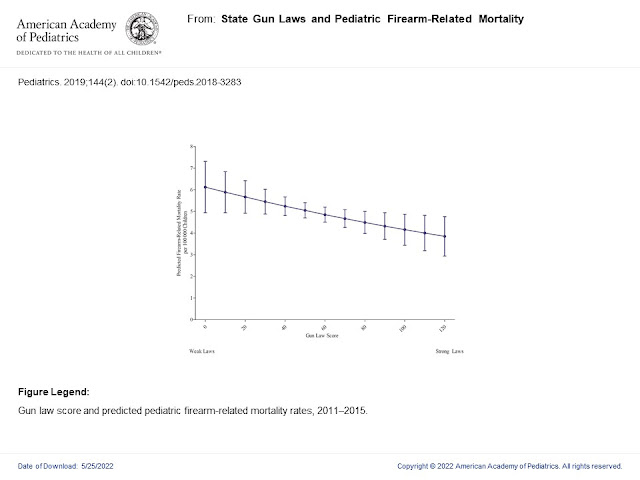
With another mass shooting in an elementary school, again and again, thoughts and prayers are sent. Again and again, however, we hear the same excuses that only obfuscate our discussions. Mental health is a favorite red herring although studies are clear on this issue: Mental health does not correlate with the number of mass shootings. Every country in the world has its share of problems with mental health but only the United States is exceptional when it comes to the killing of children in their schools with assault rifles. Some argue that more guns in the hands of good people make a society safer. With 400 million guns and a population of about 330 million, there is more than enough firepower for everyone. And it is utterly wishful thinking to suggest that everyone in the United States is good. These tragic incidents require not just our thoughts and prayers, but more importantly, well-informed changes in our policies. Research shows that there is one factor that correlates well with...

Be Careful with Educational Experts and Give Sara a Chance

Image
Rene Luis Tadle Repost from Facebook This came out of my memory feed today. I remember how the Aquino government together with the so-called education experts and well-experienced education managers cajoled, rammed, and made false promises to convince students, teachers, and parents to accept the wisdom of additional two years of basic education despite the objections from various sectors. Thus, in 2015, together with other groups and individuals, CoTeSCUP questioned the constitutionality of the K-12 Law in the Supreme Court. SC declared that the law was constitutional and thus dismissed our petition, noting that it is within the police power of the state to enact educational laws including the K-12 Law. However, it noted as well that “It is not for the Court to look into the wisdom or propriety of legislative determination.” (CoTeSCUP et. al, vs. DOLE et al. G.R. No. 216930). Since then, studies have shown that K-12 Law failed to live up to its promise (Orbeta et al., 2019 Manansan, 2...

Why Basic Education Matters

Image
Filipinos recently elected the son of Marcos to be their next president. They also voted for the daughter of the current president to be their next vice president. Some may think that how people vote is influenced by their education. Unfortunately, in politics, beliefs are more important. What basic education can do is so little compared to what frustration and disenchantment can. Filipinos have been experimenting with liberal politics for more than three decades. There seems to be not much difference for most Filipinos who have lived in both periods, before and after the EDSA "people power" in 1986. Education cannot miraculously change how people vote, but how people deal with politics shows the current state of education. Unfortunately, even the opposition to authoritarianism demonstrates the current predicament of Philippine education. The results of the elections have been made public quickly this time. At past 8 in the evening, nearly half of the votes have been transmit...

To Sow Discord and Divisions

Image
Our society is still facing enormous challenges. The COVID pandemic continues. Black lives still have to matter. Greenhouse gases are still rising and so are global temperatures. To address these issues successfully, concerted efforts are necessary. We must try our best to control the spread of the coronavirus. We ought to look deeply into the structural, institutional and systemic racism. For our society to avert climate change, we must act together. Yet, Virginia's new governor Glenn Youngkin chooses to sow discord and divisions. Above copied from Commonwealth of Virginia  The following are among the executive actions the new governor has taken: End the use of divisive concepts, including Critical Race Theory, in public education. Empower Virginia parents in their children’s education and upbringing by allowing parents to make decisions on whether their child wears a mask in school. Withdraw from the Regional Greenhouse Gas Initiative (RGGI). It is just day one and the governor h...

"G" Does Not Stand for Good, It Stands For Bad Grammar

Image
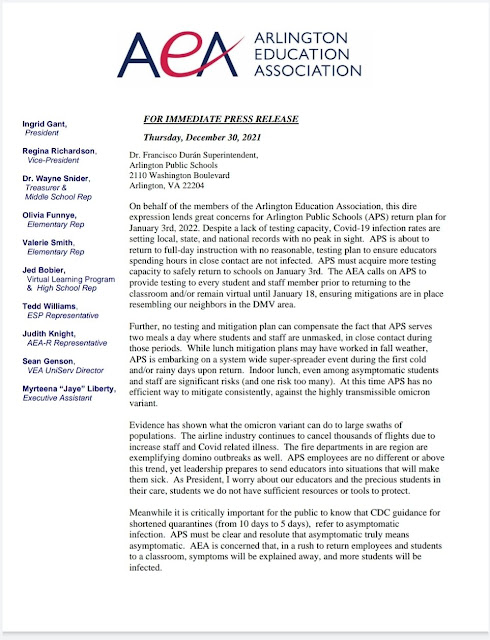
 It was a test in chemistry back when I was a first-year student in college. The instructor showed to the class the first page of my exam with a huge red letter "G" mark on it. The "G" does not stand for Good, it stands for bad grammar. Then it was followed by an exam from another student. This time, it was marked "VG", which stood for verbal garbage. At least, the content of my answer was correct. As we greet the year 2022, it seems that we are in the same place, we are missing the point. A letter from the Arlington Education Association has gone viral on social media not because of its message. Apparently, in just five paragraphs, there are numerous errors in grammar. The letter, however, brings to our attention, a very important point. Schools are about to reopen in a couple of days, and we are currently in the midst of a huge surge in coronavirus cases, and after two years through this pandemic, we still do not have the necessary testing capacity. The ...

If We Do Not Speak, Who Will?

Image
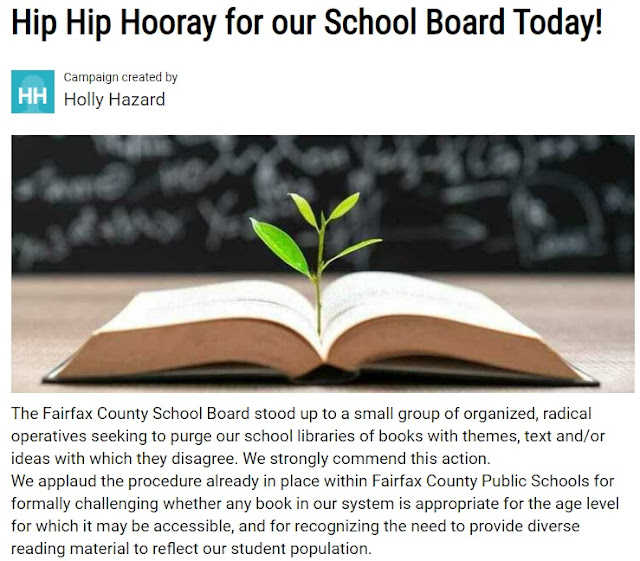
With a megaphone, one can have his voice heard more easily. Loud voices can bias our perception. Loudness should not be confused with truth. Often, loudness is simply an expression of passion, but not necessarily correctness. In a world where loudness is sometimes equated to the voice of the majority, it is especially important that we participate and support those who hold steadfast to values that benefit all our children. Parents do have a say with regard to the education of their children, but this right belongs to all parents, not just the loud ones. As calls for banning books that reach out to marginalized members of our community have become louder in our county, it is time that we stand for freedom of expression, diversity, and inclusiveness. Please join us in supporting our school board in this crucial stand. Above copied from  https://sign.moveon.org/petitions/hip-hip-hooray-for-our-school-board-today Dear Friends, I just signed the campaign: Hip Hip Hooray for our School ...

The Way We Teach Should Be the Way We See Ourselves

Image
Years ago, when I heard the retirement of the principal at the elementary school my children attended, I felt sad. He was a principal who really looked out for every child in his school. Now, it appears that I was simply selfish then. Brian Butler actually has a very important message for all educators to hear. Watching his webinar last night leaves me this impression. Much of what we teachers currently do inside our classroom does not often match how we see our own selves. I do not think we label teachers as "dumb" or "gifted". I do not think teachers think of themselves as individuals having a fixed amount of intelligence. Teachers talk with each other and learn from each other. Teachers practice discipline in their work. Lastly, teachers, I hope, prefer practices or strategies that work. Yet, in most classrooms teachers often do the opposite of these things. We label kids. We think intelligence is something we cannot nurture. We isolate ourselves. We forget the n...

Parents' Say in Education

Image
Parents should be engaged in their children's education. Society, as a whole, must share the burden of preparing its youngest members for the future. In a democracy, we exercise this obligation through the ballot box. After all, education resides in the public sphere, and as a community, we all get to decide what is good for our children. Nevertheless, there are different points of view. For this reason, it is important to focus on non-negotiable values. And with schools, equity and inclusivity are non-negotiable. For the simple reason that public schools serve public needs, schools must cater to all children. Education like medicine should also be guided by research. Education like medicine should not be based on religion or opinions, but on evidence. There is a reason why a body of experts gets to decide whether to recommend a vaccine or not. Expertise, unfortunately, is not ubiquitous, and if such decisions are left to opinions, a deadlock is very likely, especially when a socie...

Teachers Teach More than Math and Reading

Image
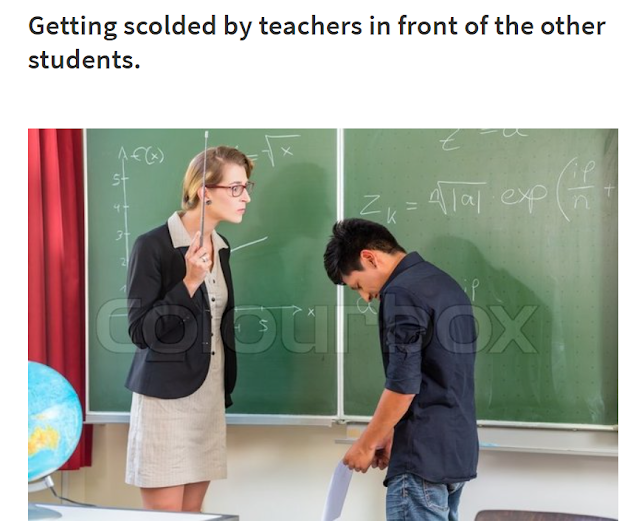
There is a growing enthusiasm for social emotional learning (SEL). It does make sense to focus not just on the academic side of education. Education must be holistic. The academic, social and emotional needs of a child must be met. Unfortunately, a greater recognition for the importance of SEL sometimes misses the fact that unlike academic goals, SEL is often caught and not taught. How a teacher treats his or her students dramatically affects the social and emotional well-being of a child. This beats any formal teaching of self-awareness, self-management, social awareness, relationship skills, and responsible decision making. It is more about what we actually do and not what we say. Mashi Liyanage, a seventeen year old, writes in a blog an experience she always remembers from her 7th grade, "In my school life, there are many things that scare me. Getting punished for not doing homework, going late to the school, getting low marks on my exams and many more. But there is one thing ...

Equity Is Possible Without Sacrificing Excellence

Image
The class of 2025 of Thomas Jefferson High School for Science and Technology in Fairfax County has greater diversity. By removing the admission fee and entrance examination, and introducing a more holistic view of applicants plus assigning slots to middle schools, we now have one in four students (25%) from economically disadvantaged homes. That is a marked improvement from 0.6% in the previous class. The grade point average of accepted students for the class of 2025 is 3.95, similar to previous classes. Equity is indeed possible without sacrificing excellence. Above copied from NBCWashington Equity being possible without doing away with excellence is surely an important lesson to be learned. However, there is an additional lesson that we should not miss. Albeit the class of 2025 is larger than previous classes, it is still evident that available slots still fall short of the number of students who wish to enter a special school for science and technology. The demand is great, which is...

Facebook's Aim Is to Make Money and Not Raising Your Child

Image
Two years ago, there was a discussion on Intelligence Squared on whether Facebook is damaging society. Supporting this motion were Damian Collins, chair of the House of Commons Digital, Culture, Media and Sport Committee and Nina Schick, technology expert, and advisor to former NATO Secretary General Anders Fogh Rasmussen. Against this motion were Dex Torricke-Barton, former head of executive communications for Facebook, and Ed Vaizey, former Minister for Culture, Communications and Creative Industries (2010-2016). The discussion was chaired by Helen Lewis, staff writer on The Atlantic and former associate editor of the New Statesman. At the end of the discussion, the audience was asked to cast their votes and 60 percent agreed that Facebook is a menace to society. Above copied from Intelligence Squared Fast forward to present, our representatives on Capitol Hill are now asking the same question, but this time, there is an emphasis on how Facebook is affecting our children. In a Senate...

National Merit Scholarship Semifinalists: Not Even One Student from Mason District Schools

Image
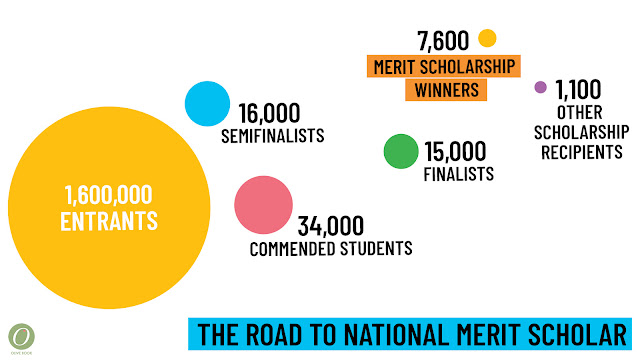
In a recent newsletter, Mason District School Board Member Ricardy Anderson commented on the news of 214 high school students in Fairfax County Public Schools (FCPS) being recognized as semifinalists for the National Merit Scholarship. Dr. Anderson wrote, "...I am concerned that none are from the comprehensive high schools in the Mason district. It’s imperative that staff identify the barriers that hinder performance and create a plan to promote more equitable representation from Falls Church, Justice and Annandale High Schools." Before questions regarding equity can be raised, it is useful to look at what is required to be recognized as a semifinalist in the National Merit Scholarship. The requirement is straightforward, to score in the top one percent on a test called PSAT. PSAT is a standardized test on reading, writing and language, and math. To become a semifinalist, one therefore has to be good at taking standardized tests. It is not a test for aptitude, intelligence or...

Echoes from the Past

Image
Roughly fifteen years ago, an event was held at the Wilson Center in Washington, DC . The event was a discussion on a gloomy outlook on the current state of the Philippines then. Philippines president Arroyo just survived "Hello, Garci" with her allies in Congress succeeding in stopping her impeachment. A commentator for the event, Hazel McPerson, a professor of political science at George Mason University, stated that one of the reasons the Philippines finds itself in a quandary was a weak public educational system. Basic education in the Philippines has failed miserably that most poor children would miss out on benefits of a good government. That failure in education is so evident that we do not even know our history well enough to understand who we are and what we need to do in the present for future generations. History has a lot to tell us about the Philippines today. Unfortunately, we often look at Philippine history in segments and therefore miss the overarching lesson...

Philippines' Basic Education Problems: COVID-19 and Beyond

Image
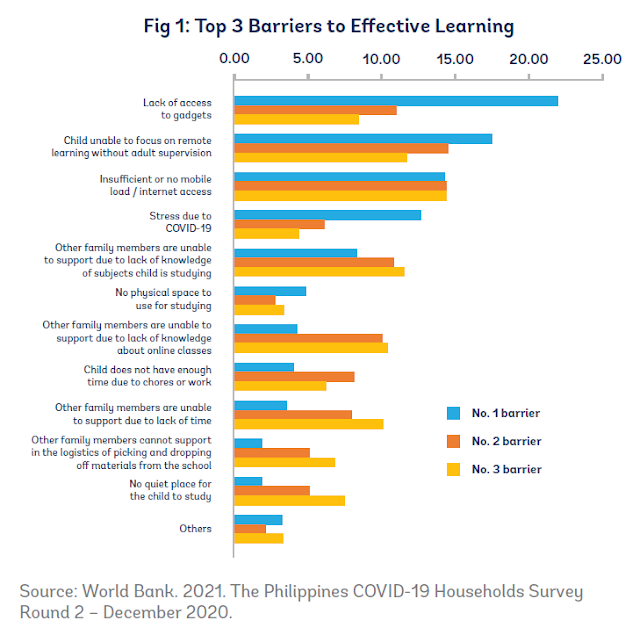
I still teach my class remotely. With a large class of more than a hundred students, it is very difficult to implement contact tracing in case a student in my class does test positive for the coronavirus. I do not like teaching remotely. I am not able to receive instant feedback by simply observing the expressions on my students' faces. The pandemic does bring some new challenges in both teaching and learning. The situation in the Philippines, however, is different. What the current pandemic has magnified are the same persistent problems basic education in the Philippines faces. With schools not having adequate restrooms or wash stations, it is not really easy to attend to the necessary hygiene measures. With crowded classrooms and high pupil to teacher ratios, it is not really possible to keep an eye on each student and maintain social distance. The lack of resources (school facilities and learning materials) exists even before the pandemic. And as important, children not finding ...

Schools Remain Closed in the Philippines

Image
While most K-12 schools in the United States have reopened to in-person classes this school year, the United Nations Children's Fund (UNICEF) tells us that about 140 million children are still waiting for their first day to attend school. Among countries that have not reopened schools is the Philippines. The country is currently facing a surge in COVID cases and vaccination has only reached seventeen percent of the population. Above copied from PhilStar A teacher's group in the Philippines, Teachers' Dignity Coalition , recently criticized the plans of the Department of Education to hold webinars for teachers: Most schools were closed last year and we do have plenty of lessons to learn regarding what is important in both teaching and learning. In an article, " Adapting and Enduring: Lessons Learned from International School Educators During COVID-19 ", published in the Journal of Research in International Education, these lessons are summarized: Technology Access ...